Vitamin D/Calcium for Bones
How much vitamin D and calcium should we take for bone health? Are supplements needed?

We typically screen for osteoporosis with a bone mineral density scan for women when they turn 65, and younger women at increased risk, per the U.S. Preventive Services Task Force current guidelines. When someone has osteoporosis, there are a variety of treatment recommendations, sometimes varying according to who constructed them, but generally involve taking vitamin D (800–1,000 units/day) and calcium (1,000-1,200 mg/day), ideally through dietary intake; otherwise, by supplements. One example of treatment recommendations is here.
A common question is what women without osteoporosis should take to prevent it, especially as far as supplements go. The link immediately above recommends the same vitamin D and calcium supplements, but the evidence does not support that.
A new review in JAMA (online May 1, 2024) looked at long-term data from the Woman's Health Initiative (WHI). 36,282 women enrolled in the calcium and vitamin D supplementation trial were followed for up to 20 years. Among other goals, "Calcium and vitamin D supplements were studied in the WHI because previously they had been tested primarily in populations with osteoporosis or low bone mineral density, and no prior randomized controlled trial had evaluated the benefits and risks of calcium plus vitamin D supplementation among postmenopausal women with typical fracture risk."
After reviewing long-term data, the researchers concluded:
Audio podcast of this blog available at https://podcasters.spotify.com/pod/show/joe-breault-md-scd/episodes/Vitamin-DCalcium-for-Bones-e2j6kjf
A combined calcium and vitamin D supplement was not associated with reduced risks for hip fractures among postmenopausal women at average risk for osteoporosis, according to the study. However, the authors note that supplements can help fill nutrient gaps among women who do not meet the daily recommended intake for these nutrients. Therefore, women with questions about adequate intake and levels should consult with their healthcare provider.
The current primary prevention of fracture recommendation from the U.S. Preventive Services Task Force (USPSTF) is:
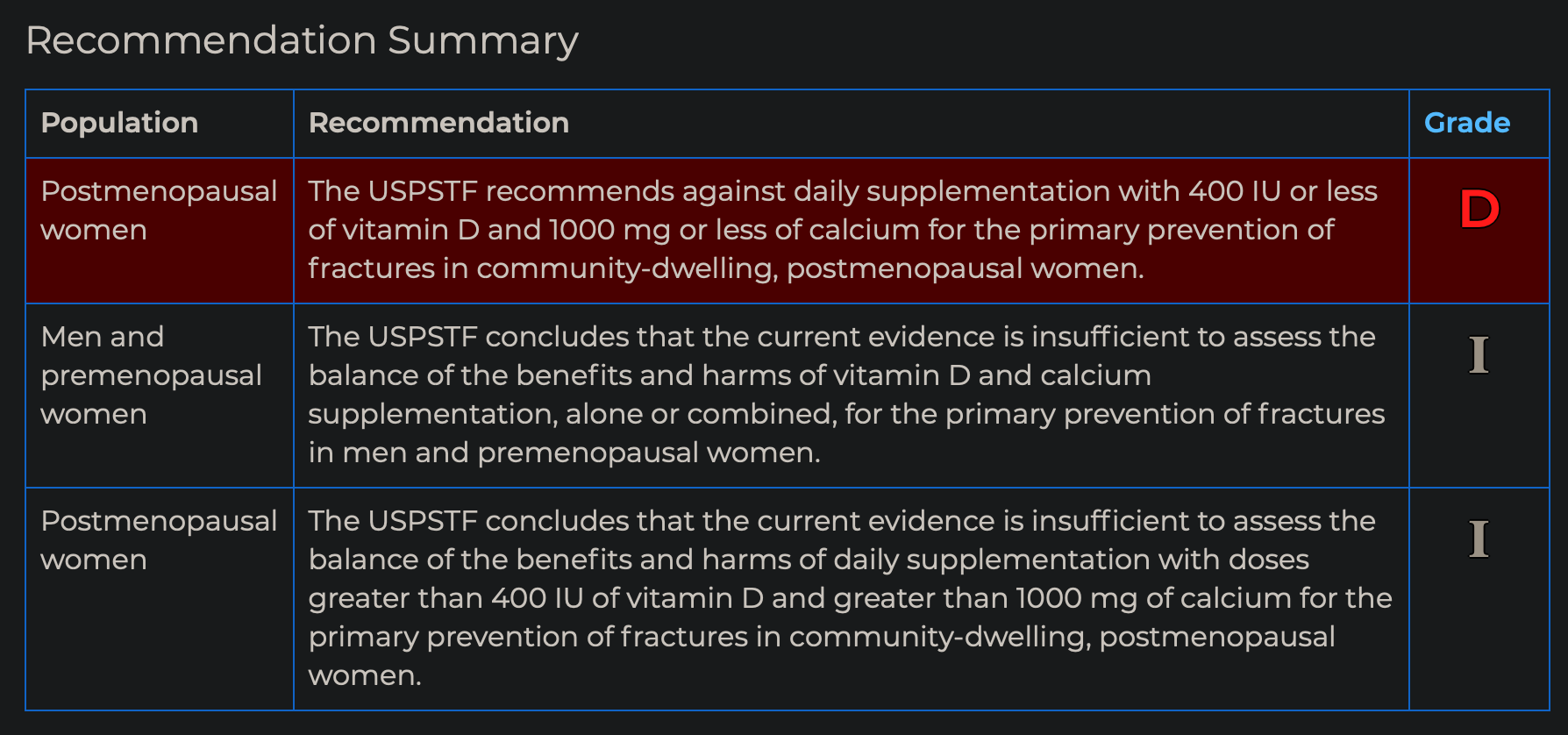
"The USPSTF concludes that the current evidence is insufficient to assess the balance of the benefits and harms of vitamin D and calcium supplementation, alone or combined, for the primary prevention of fractures in community-dwelling, asymptomatic men and premenopausal women. (I statement) The USPSTF concludes that the current evidence is insufficient to assess the balance of the benefits and harms of daily supplementation with doses greater than 400 IU of vitamin D and greater than 1000 mg of calcium for the primary prevention of fractures in community-dwelling, postmenopausal women. (I statement) The USPSTF recommends against daily supplementation with 400 IU or less of vitamin D and 1000 mg or less of calcium for the primary prevention of fractures in community-dwelling, postmenopausal women. (D recommendation) These recommendations do not apply to persons with a history of osteoporotic fractures, increased risk for falls, or a diagnosis of osteoporosis or vitamin D deficiency."
As a primary care physician, I recommend that everyone, regardless of osteoporosis, gender, or age, have a healthy diet with adequate vitamin D and calcium meeting the recommended intake of these nutrients. The recommended calcium intake varies by age and gender (see link), but it is about 1,000 mg. The recommended vitamin D intake varies by age and gender (see link), but it is about 600-800 units.
If there is osteoporosis, assess the diet for how much vitamin D and calcium one is getting on average, and if needed, supplement them to reach the goal in the first paragraph above. Otherwise, supplements of these are not needed for primary prevention of osteoporosis.
A previous blog post of mine on the Cosmos Trial noted that a specific daily multivitamin did help memory in older adults, and many may want to take it daily. The one recommended included 1,000 units of vitamin D and 220 mg of calcium.
The Dietary Guidelines for Americans list the food sources of calcium at https://www.dietaryguidelines.gov/food-sources-calcium and of vitamin D at https://www.dietaryguidelines.gov/resources/2020-2025-dietary-guidelines-online-materials/food-sources-select-nutrients/food-sources - with this information, anyone can adjust their diets to get the vitamin D and calcium recommended from foods rather than supplements.