Solar Viewing
How do you view solar eclipses and understand what you are seeing?
We were blessed to see the total solar eclipse with good friends on the shore of Lake Palestine in La Rue, Texas. This was my second total solar eclipse—I went to Columbia, South Carolina, for the last one on 8/21/2017. They are so spectacular that we discussed going to Spain or Iceland for the next one on 8/12/2026.
Virtually everyone is interested in seeing solar eclipses, even if not in the path of totality. The NASA Eclipse Website notes an eclipse in 1375 BCE described in early Mesopotamian Records as:
On the day of the new moon, in the month of Hiyar, the Sun was put to shame, and went down in the daytime, with Mars in attendance.
A total solar eclipse begins with a partial eclipse as the Moon moves across the Sun. As more of the Sun is covered, it becomes a shrinking crescent. The temperature drops, the color saturation of the surroundings fades, animals seem to freak out, and we can see planets or bright stars.
Totality begins with the breathtaking diamond ring effect, the last bright flash of sunlight that creates a shining halo around the Moon's silhouette. This occurs just before the Moon completely covers the Sun. Immediately following this, the phenomenon of Baily's beads occurs. These are caused by sunlight streaming through the lunar valleys along the Moon's edge. An English astronomer, Francis Baily (1774–1844), described them during an annular eclipse of the Sun on May 15, 1836. Though named after Bailey, Sir Edmond Halley made the first recorded observations of Baily's beads during the solar eclipse of May 3, 1715.
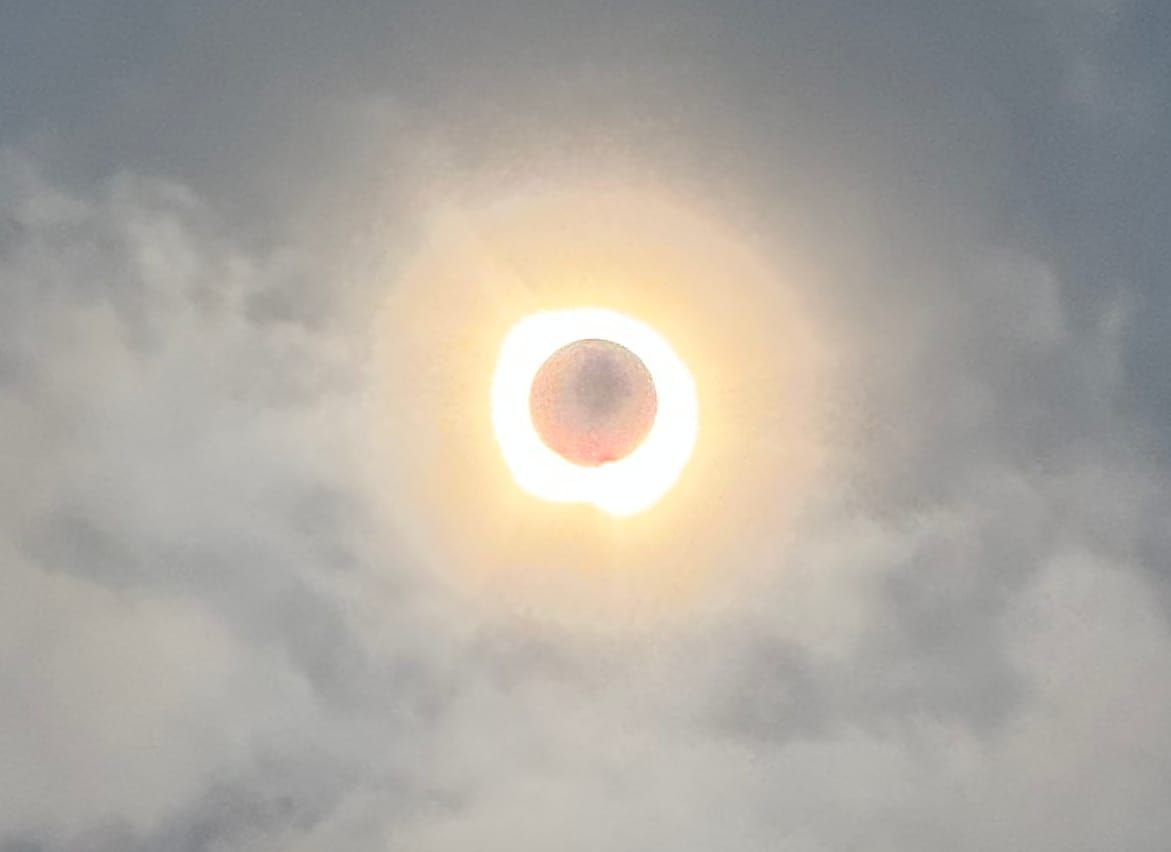
During totality, when the Sun is completely covered, the day turns into an eerie night-like darkness. The corona, the Sun's outer atmosphere, becomes visible as a radiant halo around the darkened Moon (see my photo above). This is the only time the corona can be observed with the naked eye, appearing as white, wispy threads extending outwards (though my iPhone photo above does not show the fine thread details). Totality provides a unique opportunity for scientists to study the Sun's outer atmosphere, including its temperature, composition, and dynamics. Solar flares or coronal mass ejections can also be observed.
Totality lasts only a few minutes at most. As the Moon moves past the Sun, the processes of the initial phase reverse. The diamond ring effect reappears, signaling the end of the total eclipse. Daylight gradually returns as the Moon moves entirely away.
Safety
Special solar glasses are needed to view the Sun safely. The cardboard frames with solar film for the eyes can cost from $1 to $15 on Amazon(#ad) and should be AAS-approved, CE, and ISO-certified. Always check before use to be sure that the solar film is not scratched. If you do not have the special solar glasses, you can put a pinhole in a piece of cardboard and view the changing solar crescent on the projected image of the ground or piece of paper.
Once the few minutes of totality start, you can look at the solar eclipse with the naked eye. But in the hour or so on either end, as the Sun slowly disappears and then reappears, be sure to wear proper solar glasses - as we were doing below:

Newspapers run stories about eye damage from people looking at the Sun during eclipses. The USA Today report sounds scary. The CNN report shows how to tell if your eyes were damaged. NPR was more reassuring. Always put safety first and wear solar glasses.
Binoculars, DSLR cameras, Telescopes
You can view the solar corona during totality with plain binoculars, cameras, or a telescope, just as you can look at it directly with your naked eyes. You will see it better than the blurry iPhone photo above.
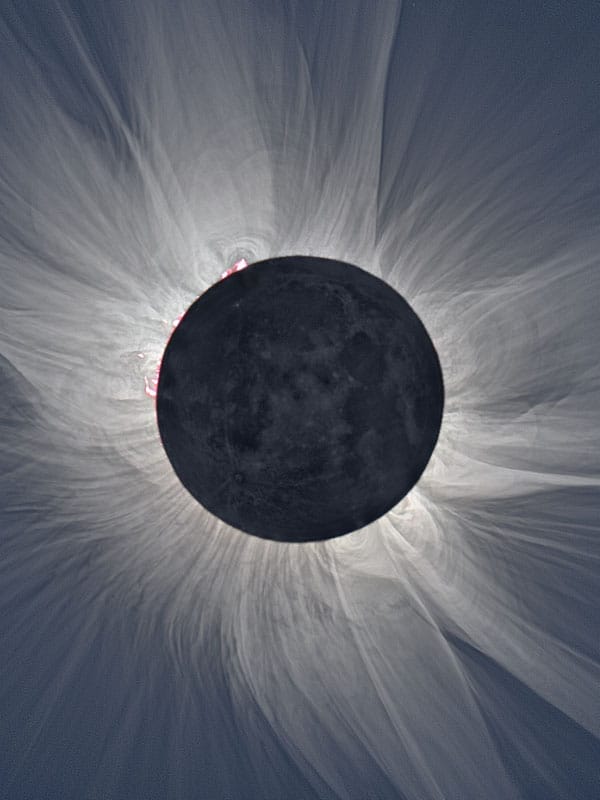
The National Solar Observatory's image of the solar corona below shows the wispy threads of the solar corona extending outwards during a total solar eclipse in contrast to the blurry corona image from the iPhone photo above. Of course, they were using a powerful telescope.
Binoculars, cameras, and telescopes can use a solar filter on the lenses to allow the Sun to be safely viewed directly. These specialized films from Badder Planetarium can fit on binoculars, cameras, and smaller telescopes. You may see sunspots with them in daily viewing and any eclipse viewing before and after eclipse totality. Ordering the filters through Company 7 in Maryland may be better, as they can provide advice and customer service.
For those interested in a more scientific review of the solar corona, I'd recommend a book by Leon Golub and Jay Pasachoff, available from Amazon(#ad). I read it when it came out and found it beautifully written, which explains what we know about the solar corona. Also, see Dr. Pasachoff's other books at https://sites.williams.edu/solar-corona/.
The Sun's Atmosphere
The photosphere is the lowest layer of the sun's atmosphere and is the layer that we typically see when looking at the sun (with appropriate eye protection, of course). It is effectively the "surface" of the sun. The temperature of the photosphere ranges from about 4,500 to 6,000 Kelvin. It is about 500 kilometers thick.
The chromosphere is the layer of the sun's atmosphere above the photosphere. It is usually visible only during solar eclipses or with specialized instruments, as it is overshadowed by the brightness of the photosphere. The chromosphere extends about 2,000 to 3,000 kilometers above the photosphere. The temperature in the chromosphere increases with altitude, ranging approximately from 6,000 Kelvin near the bottom to 20,000+ Kelvin at the top.
The corona is the outermost layer of the Sun's atmosphere, extending millions of kilometers into space, well beyond the chromosphere. It is extremely hot, with temperatures ranging from about 1 million to several million Kelvin. Unlike the chromosphere, the corona is usually visible only during a total solar eclipse as a white crown surrounding the Sun. The corona is much less dense than the chromosphere. It is composed of plasma that includes highly ionized atoms emitting X-rays.
The temperature at the Sun's core is many millions of degrees Kelvin, and as the radiation reaches the visible surface of the sun it has dropped to 5,800 Kelvin, which puts the radiation into the visible spectrum (~400 to 700 nm). The chromosphere is much hotter by a factor of 2 to 4. Going further out is a transition region that quickly escalates in temperature to the solar corona, which is millions of degrees, and parts of it blast off into the solar wind that spreads through space.
The common understanding of radiation and temperature only makes sense out to the photosphere. The core of the Sun is over 15,000,000 Kelvin. By the time it reaches one-third of the radius of the Sun, it drops to 6,000,000 Kelvin. The millions of degrees in the Sun's core must, as it spreads out over a broader area of an enlarging sphere, reduce in temperature until, at the Sun's visible surface, it has cooled to 5,800 K. The puzzling part of the solar temperature story is how the relatively cool photosphere doubles its temperature in the chromosphere and then skyrockets to millions of degrees in the solar corona. Why is it not cooling off more beyond the photosphere?
The answer appears to be Alfvén waves. These are magnetohydrodynamic waves that occur in plasma, the electrically conducting medium made up of charged particles, such as electrons and ions, found in stars, the solar wind, and other astrophysical environments. The Swedish physicist Hannes Alfvén first theorized these waves in 1942, and he later won the Nobel Prize in Physics for his work in magnetohydrodynamics.
Alfvén waves are non-compressible, so they are difficult to dissipate and bring their energy to the corona. They are created by shaking electromagnetic field lines and also by reconnection events of the magnetic field lines. Alfvén waves carry transverse and magnetic field disturbances and are routinely observed in the solar wind.
Total Solar Eclipses Will End!
We currently have occasional total solar eclipses because sometimes, the Moon entirely blocks out the Sun. The apparent sizes of the Sun and the Moon in the sky are similar despite their vast difference in actual size and distance from Earth. This is because the Sun is about 400 times larger in diameter than the Moon but also approximately 400 times farther away. This coincidence of ratios causes the Moon to cover the Sun entirely during a total eclipse.
However, the Moon is slowly getting further away from the Earth at about 3.8 centimeters per year. This is due to tidal forces between the Earth and the Moon. At some point, it will get so far away that it will look smaller than the Sun to us and will not be able to cover the Sun entirely. Thus, total solar eclipses will end.
Tidal forces arise because the gravitational pull of the Moon on the Earth is stronger on the side of the Earth facing the Moon. This difference in gravitational force causes the Earth to deform slightly, creating tidal bulges on both sides. As the Earth rotates, these tidal bulges are pulled slightly ahead of the Moon. This leads to a transfer of angular momentum from the Earth's rotation to the Moon's orbit, causing the Moon to move away from the Earth. This process is known as tidal acceleration.
How long before total eclipses end? I've seen calculations in the range of 500 to 600 million years. So get yourself to one before it's over! But as Laskar et al. pointed out, the calculations have many uncertainties, "mainly due to the uncertainty that remains in the tidal dissipation in the Earth-Moon system."
#ad:(full disclosure: as an Amazon Associate, I earn from qualifying purchases through amazon links, at no cost to you, which helps support this blog)