Colon Cancer Screening over 75
In the past, it was unclear if colon cancer screening was worth doing for people over 75. A new study shows that it is often life-saving.
New U.S. Preventive Services Task Force guidelines published on May 18, 2021, lowered the age for colon cancer screening from 50 to 45. Screening should continue between the ages of 50 and 75. Screening can be selectively offered for those aged 76 to 85, but the benefit is small.
A new study published online on May 20, 2021 (after the above guidelines) shows the benefits of colonoscopies in the 76-85 age group may be more than small. Let's review:
- The new study about the benefits of colonoscopy in the 76-85 age group.
- The current guidelines for the 76-85 age group.
- How to make an individualized risk-benefit ratio on a case-by-case basis.
- Why did the guidelines move the age to start colon cancer screening from 50 to 45?
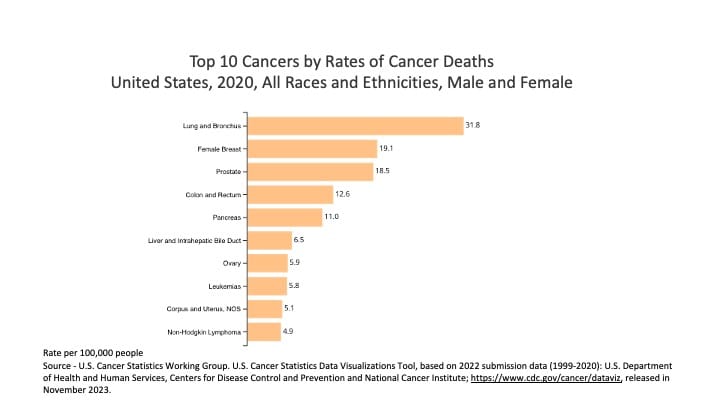
First, what are the statistics for colorectal cancer? According to the CDC data in the chart above, it is the 4th leading cause of cancer death in the United States. In 2020, the latest year for which incidence data are available, in the United States, 126,240 new cases of colorectal cancer were reported, and 51,869 people died of this cancer. For every 100,000 people, 33 new colorectal cancer cases were reported, and 13 people died of this cancer. The rate of colorectal cancer death overall has been slowly decreasing in the 20 years ending in 2020. The American Cancer Society discusses age-specific mortality trends:
Colorectal cancer mortality trends vary by age. Among older adults, decades of rapid declines have slowed, from 1% annually during 2004-2013 to 0.6% during 2013-2017 in those ages 50-64 years and from 3.3% to 2.6%, respectively, in those ages 65 and older. In contrast, colorectal cancer death rates have increased in individuals younger than 50 years of age by 1.3% per year since 2004.
An Audio Podcast of this blog is available on Spotify https://podcasters.spotify.com/pod/show/joe-breault-md-scd/episodes/Colon-Cancer-Screening-over-75-e2it6n5
The New Study
Study: Ma W, Wang K, Nguyen LH, et al. Association of Screening Lower Endoscopy With Colorectal Cancer Incidence and Mortality in Adults Older Than 75 Years. JAMA Oncol. 2021;7(7):985–992. doi:10.1001/jamaoncol.2021.1364
Findings: In 2 large prospective cohorts, including 56 374 men and women who reached 75 during follow-up, screening lower endoscopy after 75 years of age, regardless of screening history, was associated with a reduced risk of colorectal cancer incidence and related mortality. However, screening endoscopy was not associated with a benefit for colorectal cancer-related mortality among individuals with a history of cardiovascular disease or multiple cardiovascular risk factors.
Meaning: These findings provide empirical evidence supporting the continuation of screening endoscopy among adults older than 75 years to prevent colorectal cancer incidence and death, especially those who do not have significant comorbidities.
It showed that a colonoscopy after age 75 was linked with a 39% reduction in colorectal cancer incidence and a 40% decrease in the risk of death from the disease. The researchers found similar reductions in the risk of death from colorectal cancer, whether or not participants had ever undergone screening before age 75. The study calculated hazard ratios, thus, the risk reduction is (1 - HR) x 100%.
Current Guidelines for People 76-85
The U.S. Preventive Services Task Force recommends that clinicians selectively offer screening for colorectal cancer in adults aged 76 to 85 years. Evidence indicates that the net benefit of screening all persons in this age group is small. In determining whether this service is appropriate in individual cases, patients and clinicians should consider the patient's overall health, prior screening history, and preferences.
How to Make a Case-by-Case Risk-Benefit Evaluation
Based on the new study above, screening in this age group appears worthwhile unless there is a significant history of cardiovascular disease or multiple cardiovascular risk factors.
Table 1 of the study noted that cardiovascular disease was present in 24.1% of those who did not have colonoscopies over age 75 and 21.7% of those who did. The study noted:
In subgroup analyses, having a history of cardiovascular disease at 75 years of age or 3 or more comorbidities, including cardiovascular disease (myocardial infarction or stroke), hypertension, hypercholesterolemia, and diabetes, tended to mitigate the benefits of continuing screening endoscopy after 75 years of age in risk reduction for colorectal cancer related mortality, although the interactions were not statistically significant. The multivariable hazard ratios of colorectal cancer related death comparing continuation of screening endoscopy after 75 years of age, independent of screening history, were 1.18 (95% CI, 0.59-2.35) among participants with cardiovascular disease and 1.17 (95% CI, 0.57-2.43) for those with 3 or more comorbidities. Having a family history of colorectal cancer did not modify the benefits of screening after 75 years of age.
It, therefore, seems reasonable to use the following decision tree in deciding to recommend a colonoscopy over age 75:
- If there is a history of a heart attack or stroke (the study's definition of cardiovascular disease), do not recommend it.
- If there is hypertension + high cholesterol + diabetes, do not recommend it.
- If life expectancy is limited (e.g., terminal cancer), do not recommend it.
- If a patient does not want interventions to extend life (e.g., severe dementia with advanced directives), do not recommend it.
- Otherwise, recommend it with a discussion of potential risks (perforation, anesthesia, cardio-pulmonary adverse events, and prep side effects such as dehydration or electrolyte issues).
Colon Cancer Screening in the 40s
At the opposite end of the age spectrum, the U.S. Preventive Services Task Force lowered the recommended age for colorectal cancer screening from 50 to 45. An NPR article on March 20, 2023 stated:
If you think you're too young to get colorectal cancer, consider this: About 20,000 people in the U.S. under the age of 50 will be diagnosed this year. And an estimated 3,750 young adults will die.
"Colorectal cancer is rapidly shifting to diagnosis at a younger age," conclude the authors of an American Cancer Society report released this month. Since the mid-'90s, cases among people under 50 have increased by about 50%. It's one of the deadliest cancers in this age group.
An American Cancer Society report reporting on colorectal cancer incidence rates noted worrisome trends in those under 50:
- The declining incidence is confined to people 65 and older; since 2011, rates have been stable in people 50-64 and increasing by 2% per year in people younger than 50.
- These incidence trends are rapidly shifting the patient population younger; 20% (1 in 5) of colorectal cancers in 2019 were in people 54 years or younger, up from 11% (1 in 10) in 1995.
- Colorectal cancer death rates increased by 1% annually in people younger than 50 years of age.
- Incidence rates for advanced disease have increased by about 3% annually in people younger than 50.
Hence, the importance of screening starting at age 45.